
Layered
A contextual news extension designed to help young audiences develop a deeper
understanding of complex stories while reducing cognitive and emotional overload.
Intercurricular Group Project
Università Cattolica del Sacro Cuore & Politecnico di Milano · Milan, Italy
May 2026 – June 2026
Tools used
Miro · Figma · Google Forms
A layer, not another news source
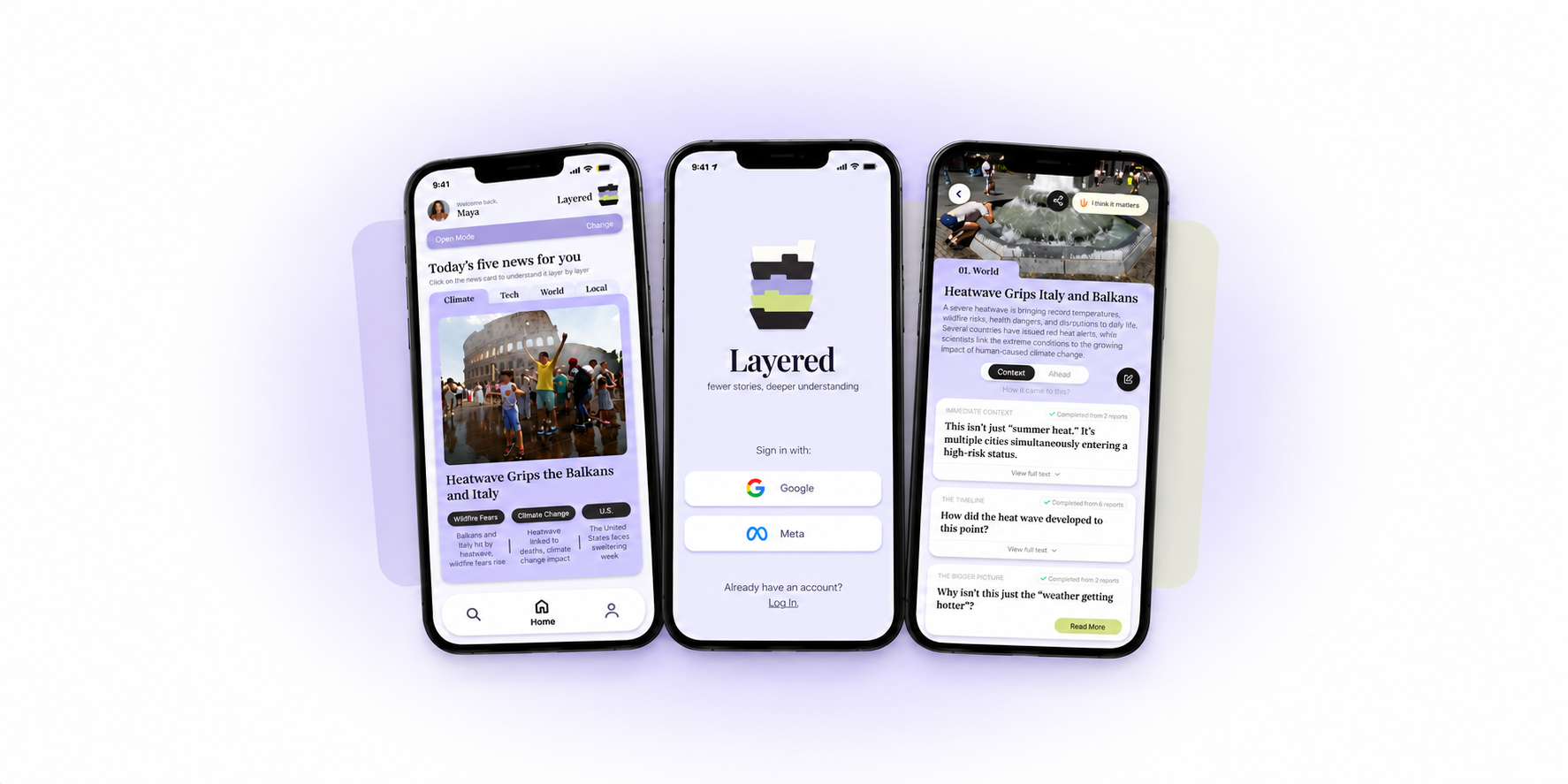
Layered is a contextual news extension designed to help young audiences develop a deeper understanding of complex stories while reducing cognitive and emotional overload.
Instead of creating another news source, Layered sits on top of an existing news provider, using source-anchored AI to organize and contextualize its reporting.
Readers can personalize how information is presented, while the original journalism remains unchanged and traceable to its source.
Overview
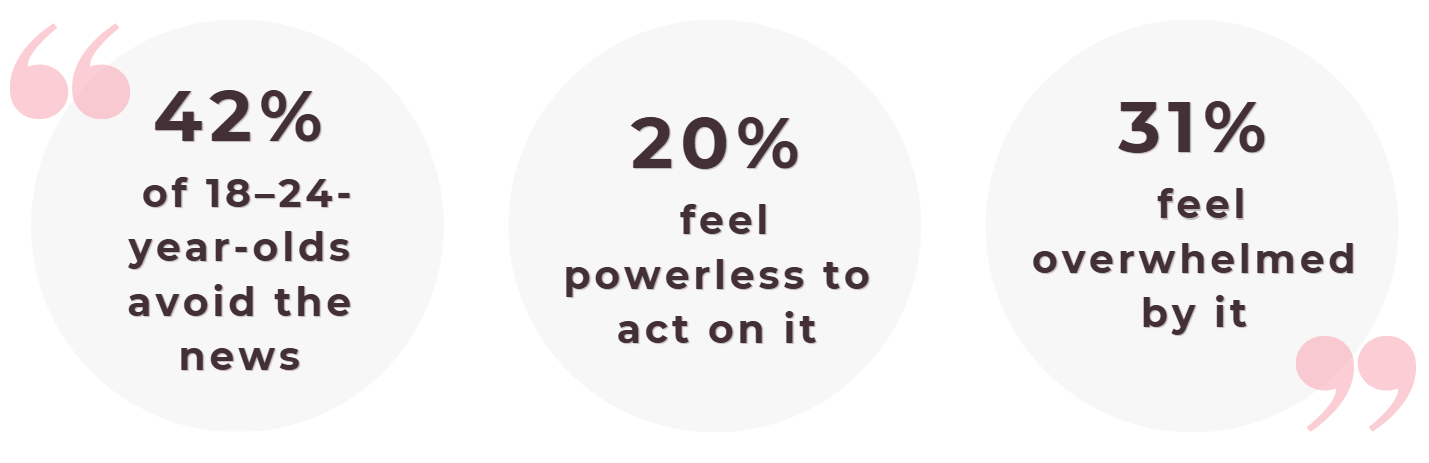
Young people are not necessarily avoiding the world. Many are avoiding the way the news makes them feel.
For Gen Z, staying informed often means navigating a constant stream of negative, fragmented, and emotionally intense information.
Instead of building understanding, the endless feed can create overload, confusion, and a sense of helplessness.
The problem
Research &
insights
Understanding why young people disengage from news
Through desk research and semi-structured interviews with news consumers and a news producer, we explored the different factors influencing how young people engage with or disengage from the news.
We organized the recurring findings into a framework showing:
the drivers of avoidance
the behaviors and emotional responses that reinforce it
the factors that can reduce avoidance
This synthesis helped us define the core challenge behind young people's relationship with news.
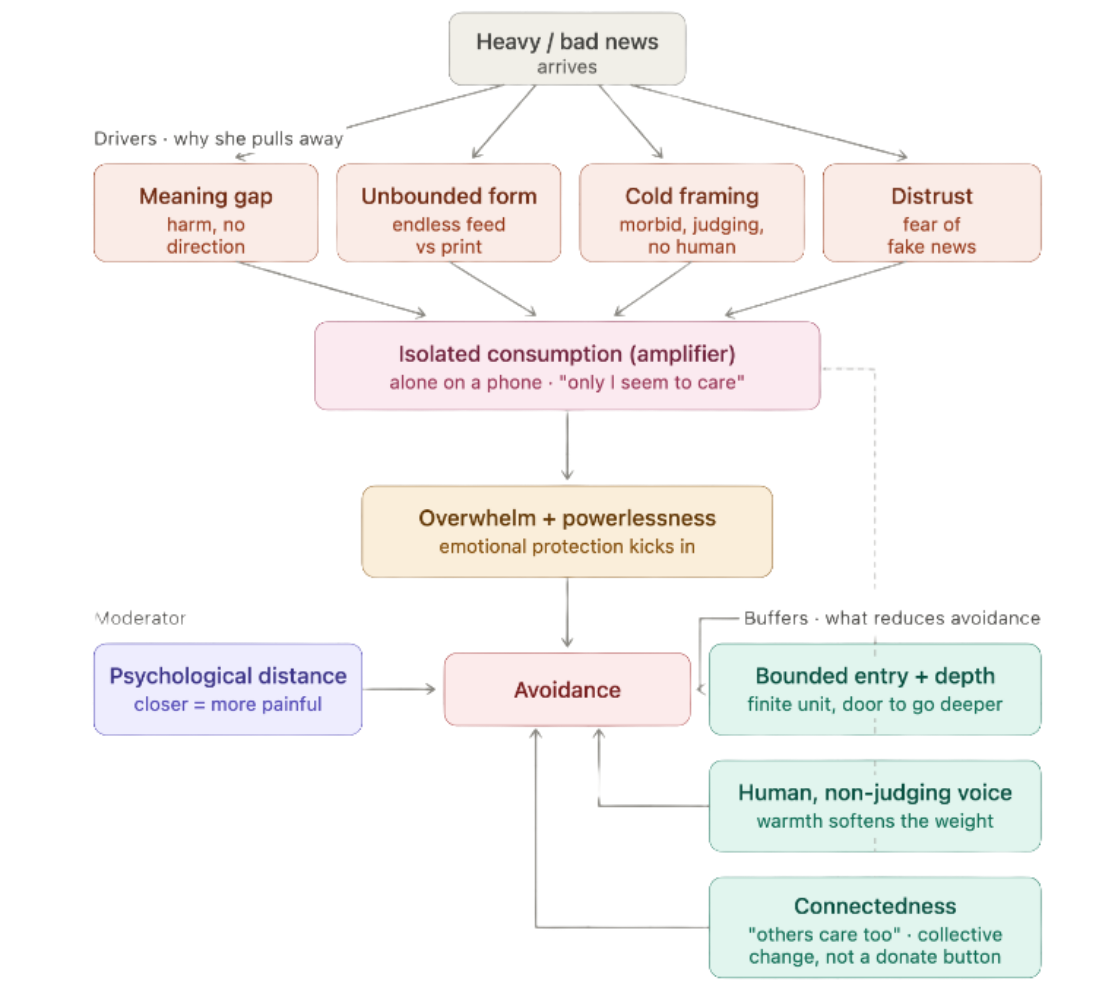
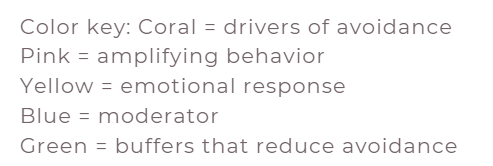
Mapping the drivers, behaviors, emotional responses, moderators, and buffers influencing news avoidance.
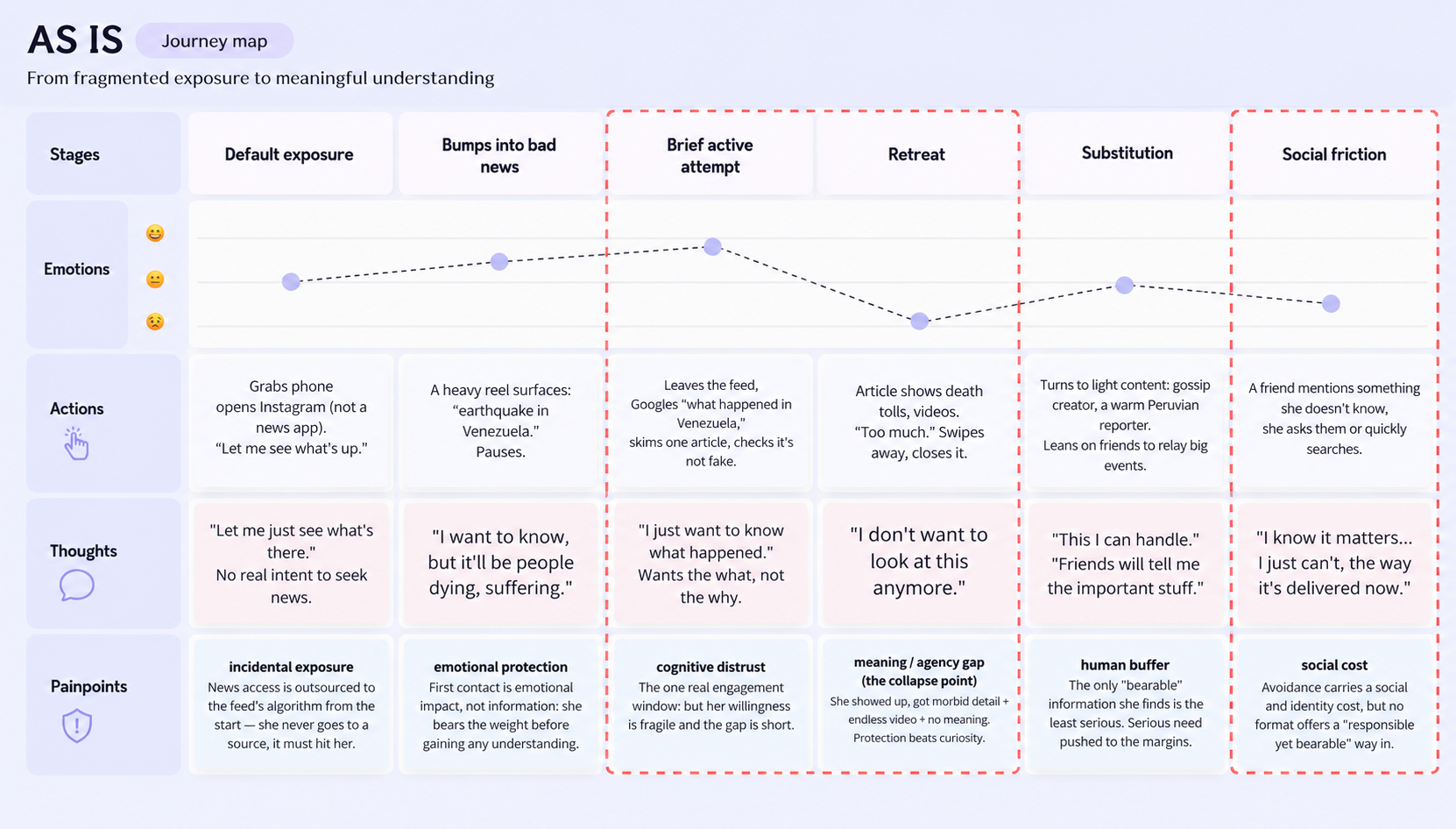
User Journey Map (as is)
The as-is journey map helped us visualize how news currently enters young people’s lives, from incidental exposure to brief attempts at engagement and eventual retreat or substitution. It highlighted the emotional, cognitive, and social pain points that make sustained engagement difficult.
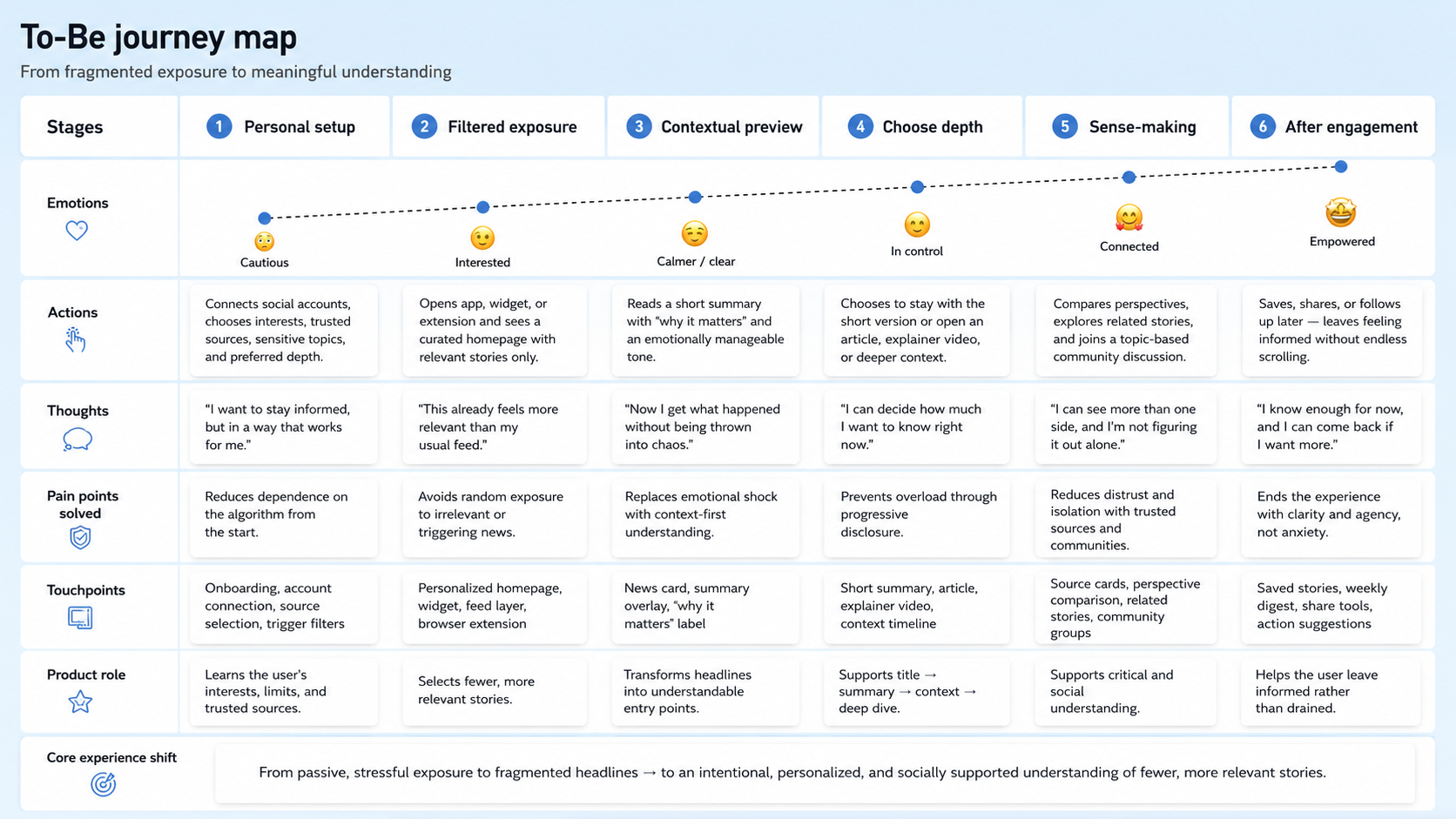
User Journey Map (to be)
We created a to be journey map to translate these pain points into opportunities, mapping how the experience could better support users throughout their news journey.
How might we transform fragmented news exposure into manageable, contextual experiences that encourage deeper understanding of fewer, more relevant stories?
Our goal
Scope &
constraints
The tension
As we developed Layered, we faced a central tension: deeper understanding requires more context, but more information can create more overload.
Our response
We addressed this by making depth progressive and customizable, breaking information into modular sections that readers can navigate, reorder, or remove based on how they prefer to process information.
Design
process
Designing around the cognitive and emotional needs of young news readers
Layered's core features were designed around the cognitive and emotional needs of young news readers.
01
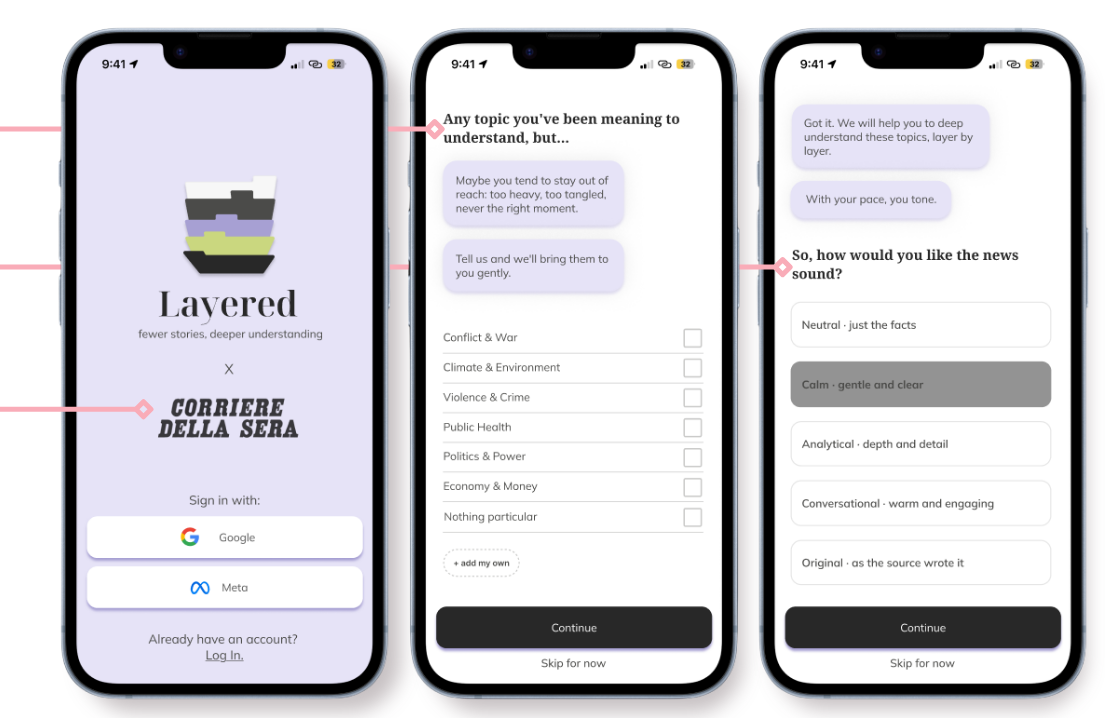
A layer, not another news source
Complex language can make news harder to process and easier to avoid.
To make reporting more accessible without compromising its integrity, Layered sits on top of an existing news provider, using source-anchored AI to organize and contextualize its reporting.
Readers can personalize how information is presented, while the original journalism remains unchanged and traceable to its source.
02
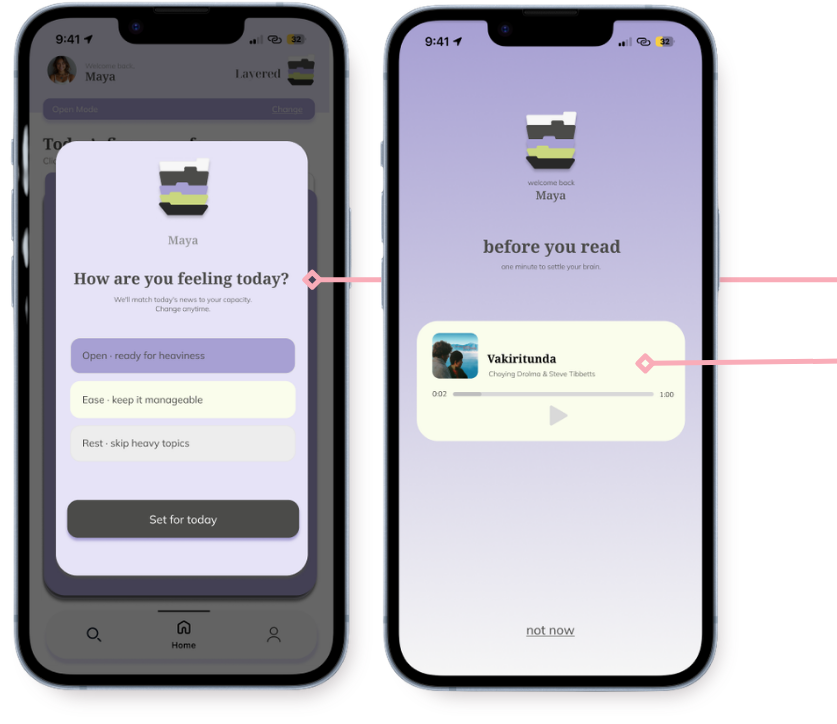
Daily check-in
The emotional weight of news emerged as a key reason for disengagement.
To make that weight more manageable, Layered begins with a daily emotional check-in, adapting the day's stories to the user's capacity, followed by a short music moment that helps them transition intentionally into the news experience.
03
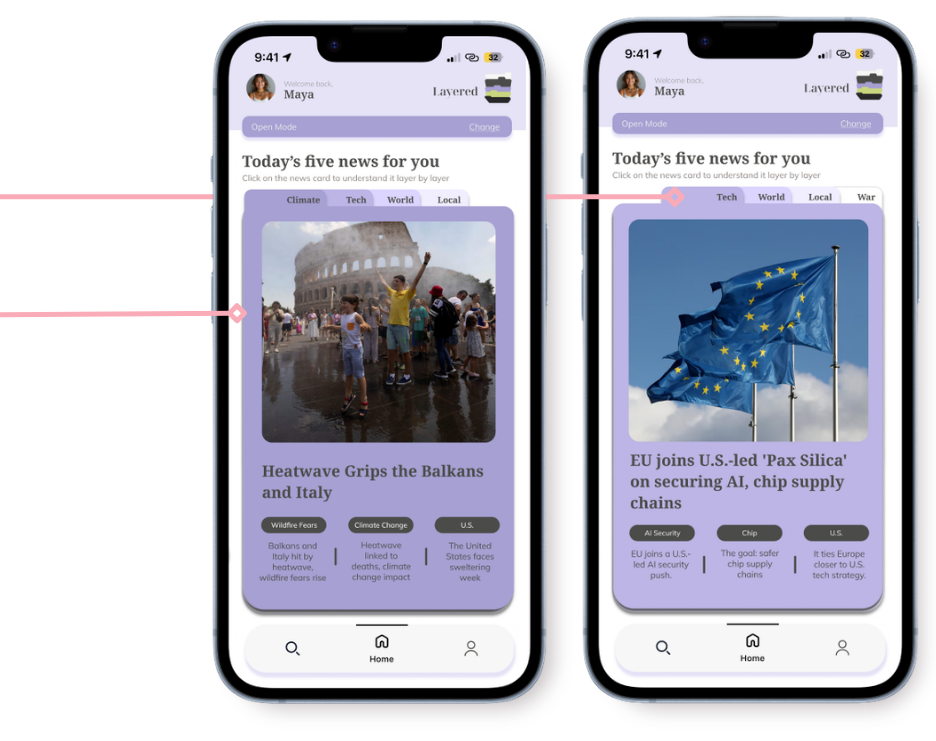
Five stories a day
Research into working memory suggests that our capacity to actively process information is limited, often estimated at around 3–5 meaningful chunks at a time.
Inspired by this principle, Layered replaces the endless feed with five stories a day.
04
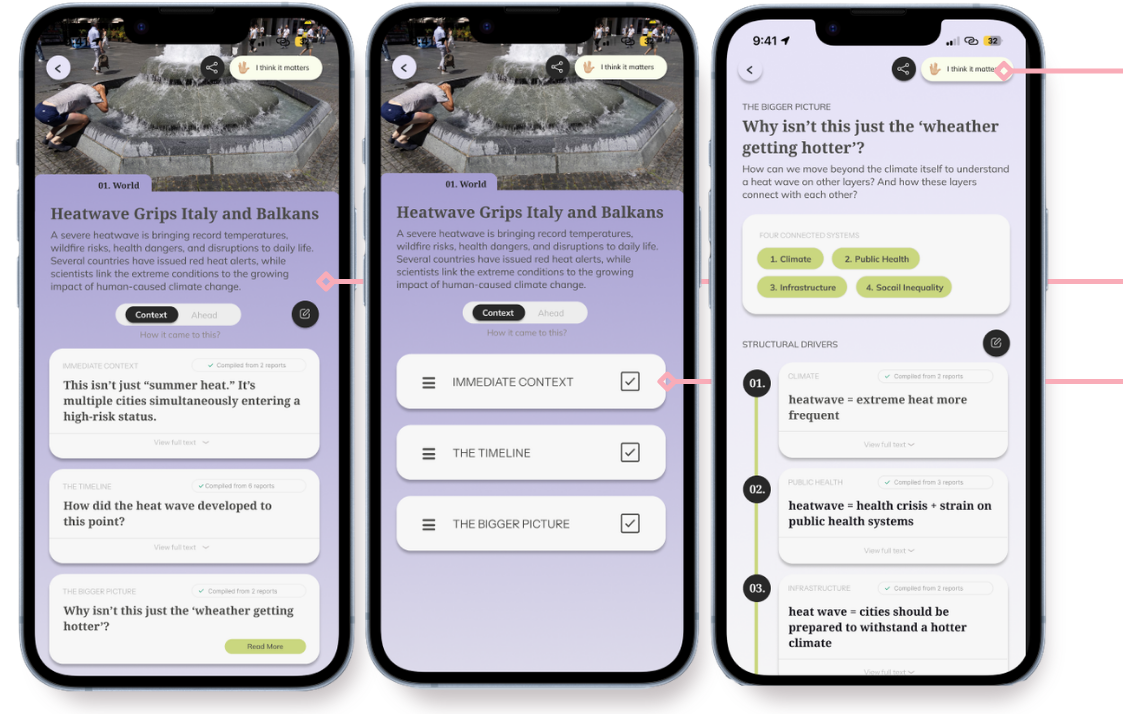
Deeper understanding
Lack of context can make complex news harder to understand and easier to disengage from.
To address this, Layered transforms each story into a journey of deeper understanding, helping readers explore its context and connections.
Readers can reorder or remove information sections to match how they process information, while the I Think It Matters button introduces a small sense of collective agency.
From consuming more news to understanding it more deeply.
Layered shifted the focus from consuming more news to understanding it more deeply. It reimagines traditional news consumption for a generation accustomed to mobile, swipe-based interactions, while deliberately moving away from the endless feeds that contribute to overload.
The result is a news experience that feels native to Gen Z without adopting the patterns that push them to disengage.
The result
Simona Naumoska · Pei-En Lee · Jingdan Yu · Zoe Recalde
My contribution:
I contributed across primary and secondary research, opportunity identification, prototyping, and usability testing.
I also advocated for a neurodiversity-friendly approach, helping shape the concept and prototype around reduced cognitive load, clear information hierarchy, and more accessible ways of engaging with complex news.
The team
Thank you for exploring my work! :)